
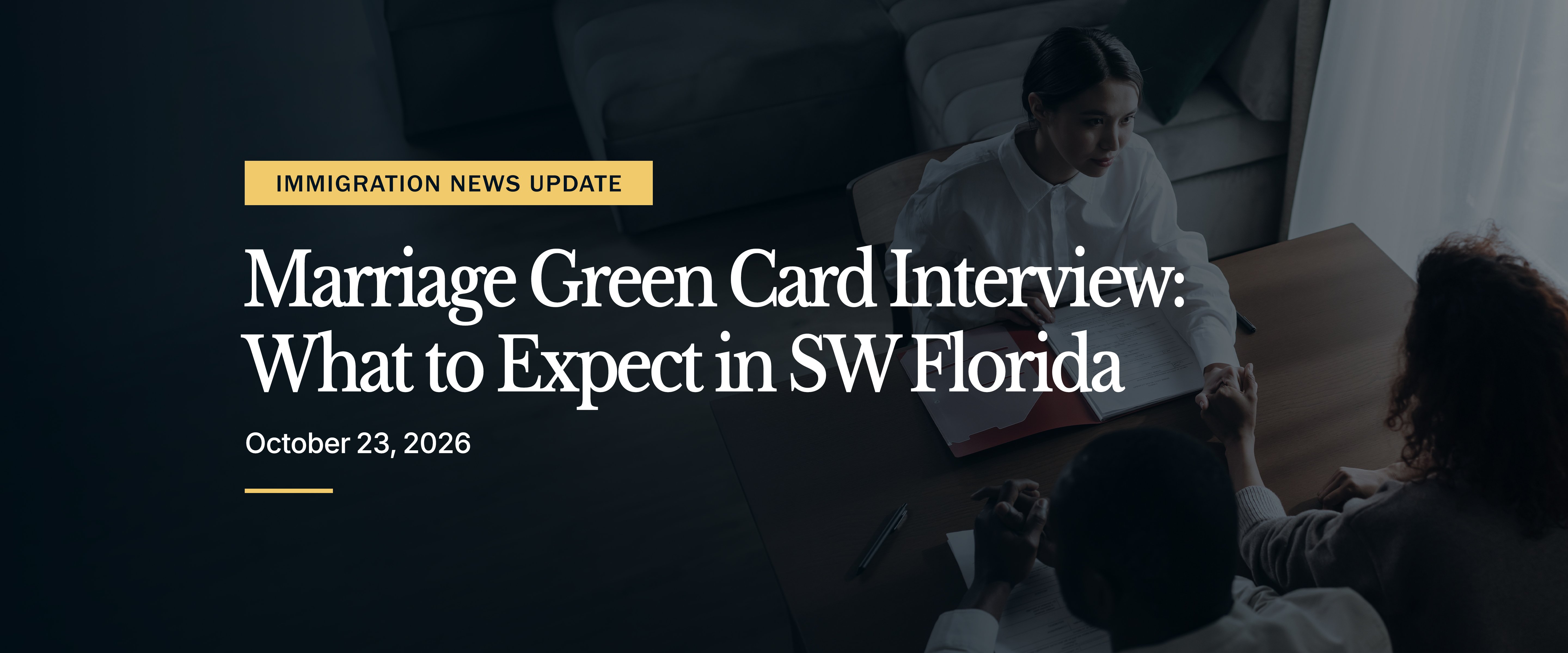
Marriage Green Card Interview: What to Expect in Southwest Florida

If you applied for a green card through marriage, an interview with USCIS is a normal part of the process. USCIS interviews green card applicants unless it decides one is not needed, and for marriage-based cases it is the usual practice. This guide covers what to expect, what to bring, and how to get ready.
Who needs to attend
Both spouses generally attend: the applicant and the spouse who filed the petition. Children applying with you must also appear. Your interview notice has the final word, so read it carefully.
In limited cases, such as military deployment or serious illness, USCIS may excuse the petitioning spouse. If that applies to you, talk with your attorney right away.
Your home ZIP code decides which field office handles your interview. For families in Lee County, that may be the Fort Myers Field Office. Confirm yours with the USCIS field office locator.
What to bring
Your interview notice has a checklist, and it is the best guide for your case. In general, families bring:
- Your interview notice, plus passports and government-issued photo ID for both spouses
- Original civil documents you submitted copies of, such as birth and marriage certificates, plus divorce decrees or other proof that any earlier marriage ended
- Recent proof of your life together, such as a joint lease or mortgage, bank and credit card statements, insurance policies, utility bills, photos, and your children's birth certificates
- Financial documents for the sponsoring spouse's Form I-864 Affidavit of Support, such as the latest tax return, W-2s, and pay stubs
- Any work permit, travel document, and Form I-94 record you have
- Certified court records for any past arrest or charge, if that applies to you
- Your medical exam (Form I-693), if your notice asks for it, still in the sealed envelope the civil surgeon gave you
- Your own copies of everything you filed, so you can follow along
Recent documents matter most, because officers want to see that your life together is ongoing. Keep the medical exam in its sealed envelope, since USCIS can return a form if the envelope has been opened or altered.
What happens during the interview
After check-in and security, you wait to be called. The officer will usually ask you both to take an oath to tell the truth.
First, your application. The officer goes through it with you, including anything that has changed since you filed, such as your address, job, or travel. You can correct answers, and you may be asked to re-sign.
Then, your relationship. Expect questions about daily life: how you met, where you live, your families, and your plans together. No one is expected to remember every date. Honest answers in your own words are what matter.
Spouses may be interviewed together or separately. A separate interview, often called a Stokes interview, lets the officer clarify details. If you receive a notice for one, speak with your attorney before the date. Every case is different.
If you need an interpreter
Bring your own interpreter. USCIS generally expects applicants to arrange one, though an officer who speaks your language may conduct the interview in it.
The interpreter must be an adult with valid government-issued ID, and will interpret word for word. You and the interpreter both sign Form G-1256 in front of the officer. USCIS generally prefers someone who is not a family member, and your attorney cannot serve as your interpreter.
Whether you speak Spanish or Haitian Creole, choose someone fluent in both languages and practice together beforehand.
Getting ready
- Read your notice twice and note the date, time, office, and who must attend.
- Review your filed application together, so you both know what it says and can mention anything that has changed.
- Gather your documents in one folder, with originals and copies, and add recent proof of your life together.
- If you need an interpreter, arrange one early and meet before the day.
- Plan the day itself: time off work, childcare, transportation, and extra time to arrive early.
- Talk with an attorney before the interview, especially if your history includes anything that could raise questions, such as an earlier immigration case or order, time spent out of status, how you first entered the U.S., or an arrest.
You have the right to bring an attorney, who will need a Form G-28 on file to appear with you. Even if you attend on your own, a review of your file beforehand can help you spot gaps early.
What comes after
If USCIS approves your application, your green card is mailed to you. If your marriage was less than two years old on the day you became a permanent resident, you receive a conditional green card valid for two years. If it was two years or more, you receive a ten-year card.
Conditional residents file Form I-751 in the 90 days before the card expires, so mark that date as soon as your card arrives. If USCIS asks for more evidence before deciding, reach out to your attorney right away.
|
Ready to take the next step? |
|
|
See how DeMine can help your family navigate your immigration journey. |
Schedule a consultation |
This article is general information, not legal advice, and does not create an attorney-client relationship. Every case is different. | Contact us for a consultation about your situation.